
Protostar
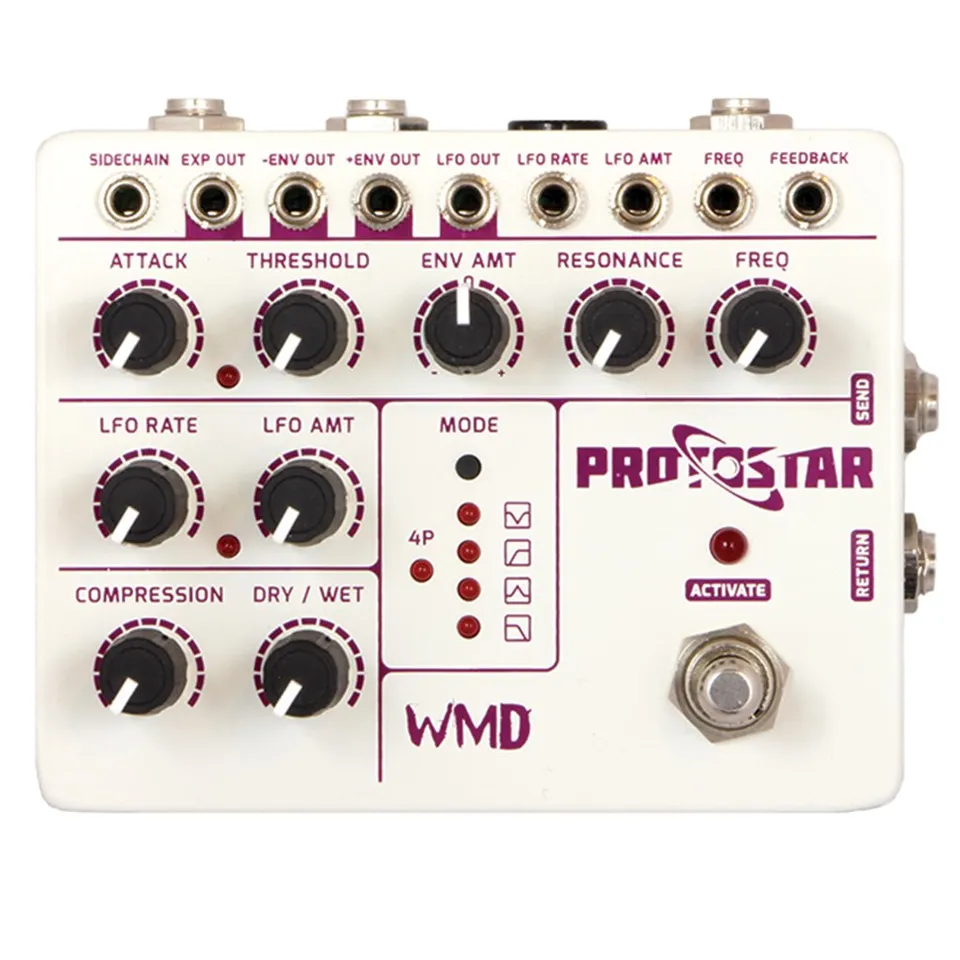
Envelope Filter
1Introduction
Hello! Thank you for purchasing the WMD Protostar.
Continuing WMD's tradition of powerful envelope filters, the Protostar brings some modular synth flair onto your board with voltage control, high headroom, and patchability.
The architecture of this filter is similar to the Super Fatman, but with the addition of two and four pole filters and a notch (resonance down for phaser like effects). Distortion and noise are lower, headroom is way higher, but the envelope gives the same natural expressiveness.
This quick manual will get you acquainted with the patch points, controls, and some baseline settings. Explore all you want, you can't break it! For more inspiration, check WMDevices.com for some videos.
As always, any issues, just contact us and we will take care of you.
2Knobs
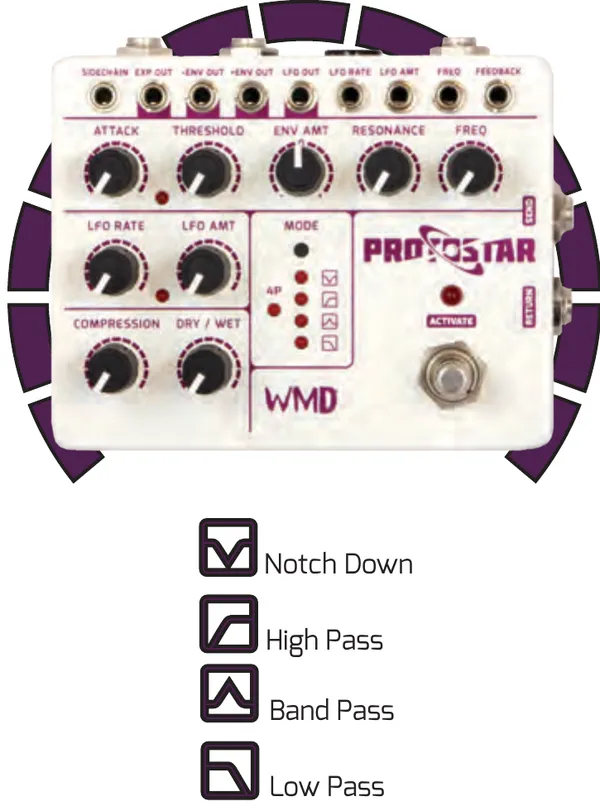
- Attack:
- How fast the envelope will react to the incoming signal. Controls both attack and release.
- Threshold:
- How sensitive the envelope is to the incoming signal.
- Env Amt:
- Attenuverter that controls how much the envelope will affect the frequency of the filter, either negatively or positively.
- Resonance:
- Synonymous with feedback or Q, this is a boost of the frequencies around the frequency cutoff.
- Freq:
- Also known as cutoff, this knob's position dictates the resting place of the frequency cutoff.
- LFO Rate:
- Make the LFO go faster or slower with this knob.
- LFO Amt:
- How much the LFO will affect the frequency cutoff.
- Compression:
- End of chain compressor squashes the wet signal to suppress unwanted honks, and resonant oddities.
- Dry / Wet:
- Amount of unaffected vs. affected signal coming through the output.
3Jacks
- Sidechain:
- Direct input to the envelope follower. Normalled to the input, use this to have the envelope follow an external source.
- Exp Out:
- Output for the expression pedal input. Exp isn't connected to any control internally and must be patched.
- -Env Out:
- Always sending +5V until the envelope is triggered, bringing the voltage down to 0V and back.
- +Env Out:
- Sends a CV signal following the envelope. Signal is 0V to +5V.
- LFO Out:
- Constantly sends the triangle wave LFO CV signal, reacts to LFO rate knob.
- LFO Rate:
- CV input for control over LFO rate. Sensitivity adjustable with internal trim pot.
- LFO Amt:
- CV input for control over LFO amt.
- Freq:
- CV Input for control over cutoff frequency.
- Feedback:
- CV input for control over resonance.
- Expression Input (back panel):
- Plug a TRS cable from any expression pedal into this, patch the exp out to what you want to control, and express yourself.
4Specifications
Specifications:
- 9VDC, Boss Style Center Negative, 300mA. Do not exceed 9V. 1A supply recommended.
- Internal Bipolar 12V power supply.
- 0-5V nominal CV range. All inputs/outputs protected.
- LFO CV sensitivity and Compressor Gain adjustable internally.
- Relay true Bypass.
- 4.9" x 3.9" x 2.4" maximum dimensions.
- Expression Pedal: 10k - 1M pot. TRS connection
- Patch Points - Mono or Stereo cable. Signals are mono.
5Support
WMD is located in Denver, CO. Reach us by email at info@wmdevices.com. For more on the Protostar, including video demos, visit the product page.