
Kraken
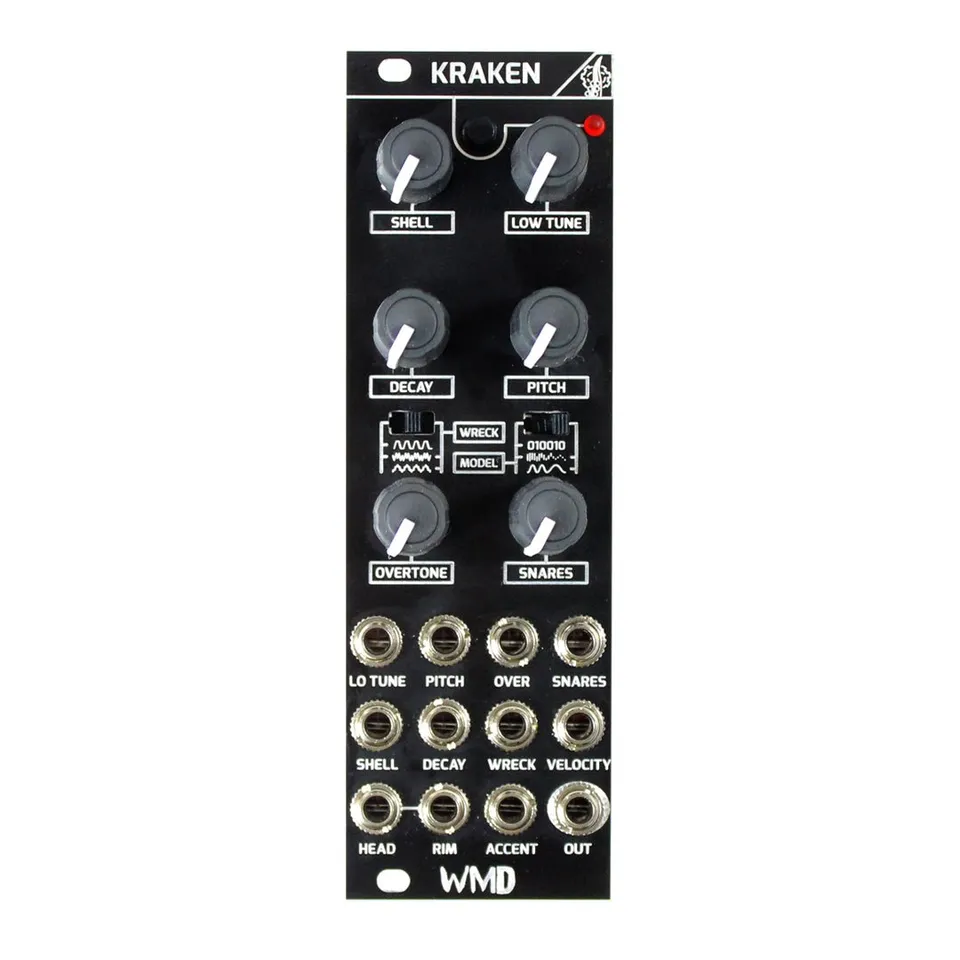
Physical Modeling Snare Drum
1Introduction
After making Crucible, WMD was fired up to make another physical modeling drum module. We heard Crucible's engine make some pretty convincing snare sounds during its development, so we knew it was possible, but tweaking that engine was out of the question. It was back to the fundamentals, starting again from scratch. Delay lines, filters, and noise. Crucible taught us physical modeling is processor intensive, so this time we began on the computer. It wasn't too long before we had a giant loop with nearly 100 filters, but it sounded like a snare. With the motivation of actually having the sound we wanted we began tearing down this massive Karplus-like loop structure into a more manageable algorithm that would run on a microcontroller. Slowly removing things and documenting their effect on the overall sound. Eventually we had something that ran fast enough, no extra processes, only what matters. After many months of tinkering and detailing we present to you Kraken, our physical modeling snare drum module. We hope it inspires you to make art you love!
2Front Panel Overview
3Controls
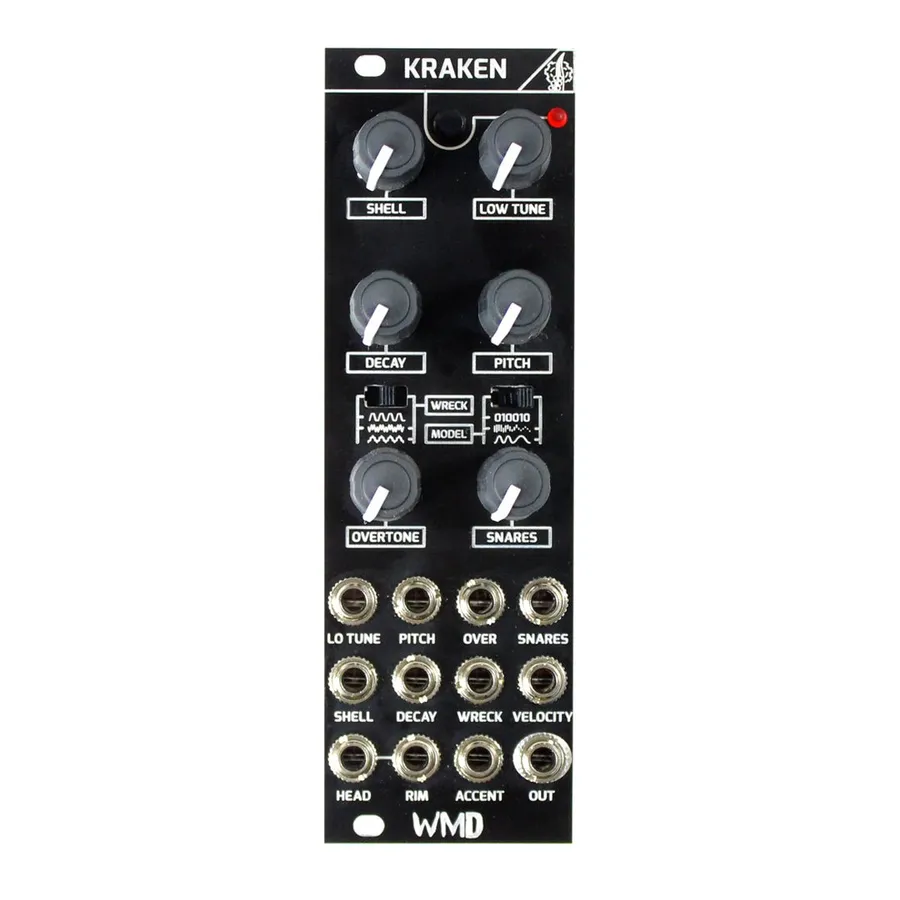
Each knob has a corresponding CV input on the front panel. CV inputs sum with their knobs, with a full sweep of 5V.
- SHELL:
- Smoothly interpolate between 32 different shell models. Each shell model determines the harmonics of the sound, with interaction from OVERTONE and SNARES.
- LOW TUNE:
- Set the fundamental frequency of the snare drum. The corresponding CV input is labeled LO TUNE.
- DECAY:
- Controls the decay parameter of the internal envelope. The envelope will remain open as long as one of the trigger inputs, HEAD or RIM, is gate HIGH.
- PITCH:
- Apply an offset to some of the shell's harmonics, allowing for finer control of the OVERTONE and SNARES timbre.
- OVERTONE:
- Control the damping level of the clean shell harmonics. Increasing this control will decrease damping, making the drum hit more resonant as the harmonics ring louder and longer.
- SNARES:
- Control the damping level of the noisy shell harmonics. Increasing this control will decrease damping, making the drum hit more noisy and making the noise tail longer.
- VELOCITY:
- Add life to your drum hits with this control. Low velocity results in softer hits with less noise and fewer overtones, while high velocities punch harder and ring out longer. Velocity is fixed around 80% max when no cable is plugged into the CV jack.
4WRECK and MODEL Switches
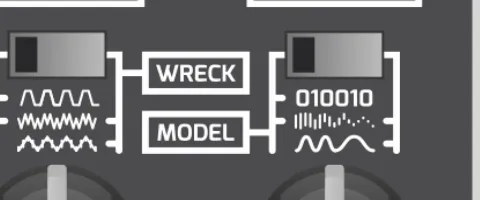
WRECK: This switch and its CV input allow you to distort the sound in various ways. When no cable is plugged into the WRECK CV jack, a fixed amount of distortion is applied. The first, fully left position is volume with hard clipping; with no cable in the WRECK jack this is effectively a clean setting. The middle setting enables a wavefolder, and the far right setting enables a distortion based on quantization error.
MODEL: Select from three models. Repeatable digital noise that produces the same sound on every trigger; analog noise that gives a slightly different sound with each hit; and finally, a pitch-shifting mode controlled by PITCH that allows you to take your sound into another dimension.
5Triggering
- HEAD / RIM:
- The HEAD and RIM inputs each trigger their own respective exciter that enters the model at different points. HEAD mimics striking a snare drum in the center, and RIM mimics striking the rim for a sidestick sound. Striking them at the same time enables a third exciter and produces a rim shot sound.
- ACCENT:
- When this jack is gate HIGH, all hits will be slightly increased in decay, amplitude, and velocity.
6Specifications
Dimensions:
- Size: 8HP
- Depth: 30mm (with cables)
Power:
- +12V: 61mA
- -12V: 17mA
Inputs:
- All CV Inputs: 100k ohm impedance. CV inputs sum with knobs; full sweep is 5V.
- Gate Inputs: 100k ohm impedance, 2V threshold Schmitt Trigger.
Outputs:
- Audio Output: 470 ohm impedance, 22Vpp range, 4.0ms latency max.