
Crucible
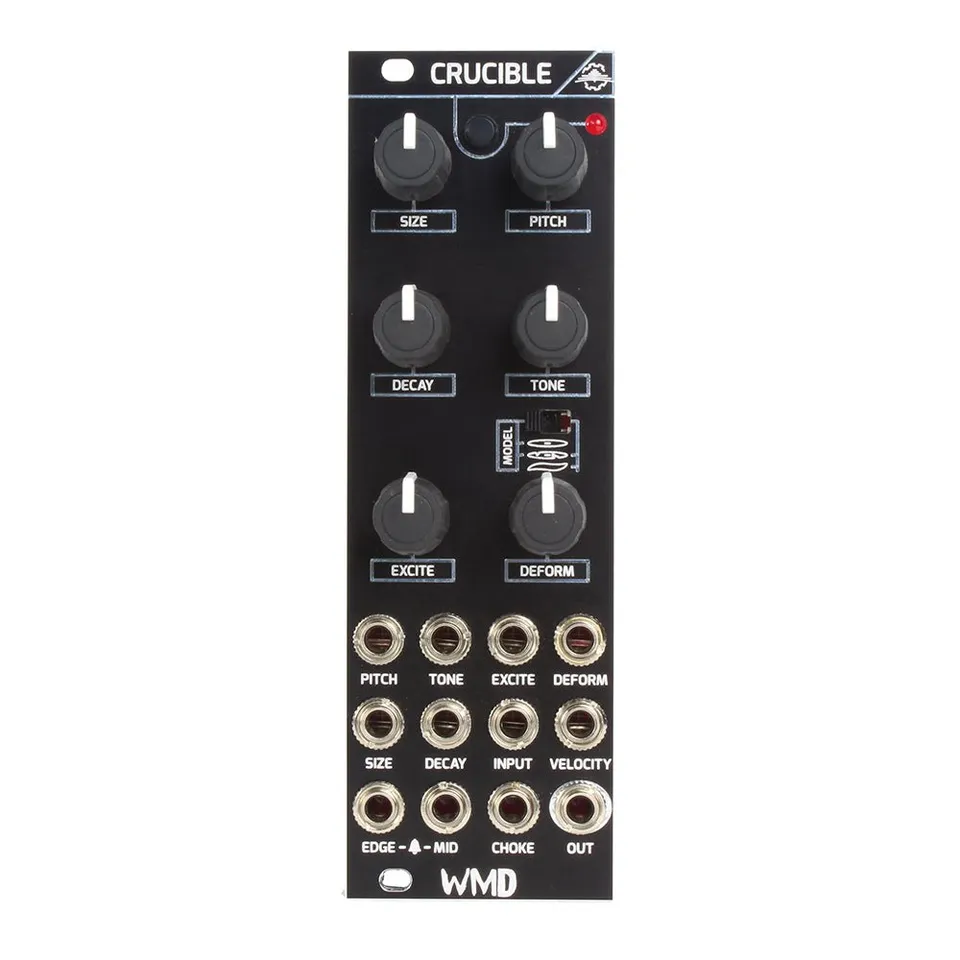
Curved Plate and Cymbal Synthesizer
1Introduction
Can a realistic cymbal sound be synthesized? Can a model be developed that actually sounds and behaves like a real cymbal? These are the questions we had to ask ourselves when we set out to make our next drum module. After many prototypes and a little serendipity we present Crucible. A true synthesizer that behaves and sounds like a real cymbal, while offering the otherworldly flexibility that can only be achieved with a synthesis model.
Crucible doesn't contain any samples. Every sound it produces is fully synthesized in real time. Behind the scenes, common digital synthesis functions like delay lines and digital filters are arranged to form an engine that provides the user with separate “Exciter” and “Model” synthesis blocks. This means Crucible's settings approximate the parameters of an actual stick and cymbal, making both classic and experimental programming intuitive and rewarding. Recreate the sizzle and swell of your favorite kit cymbal, then run your whole mix into the audio input and head into unexplored territories.
2Front Panel Overview
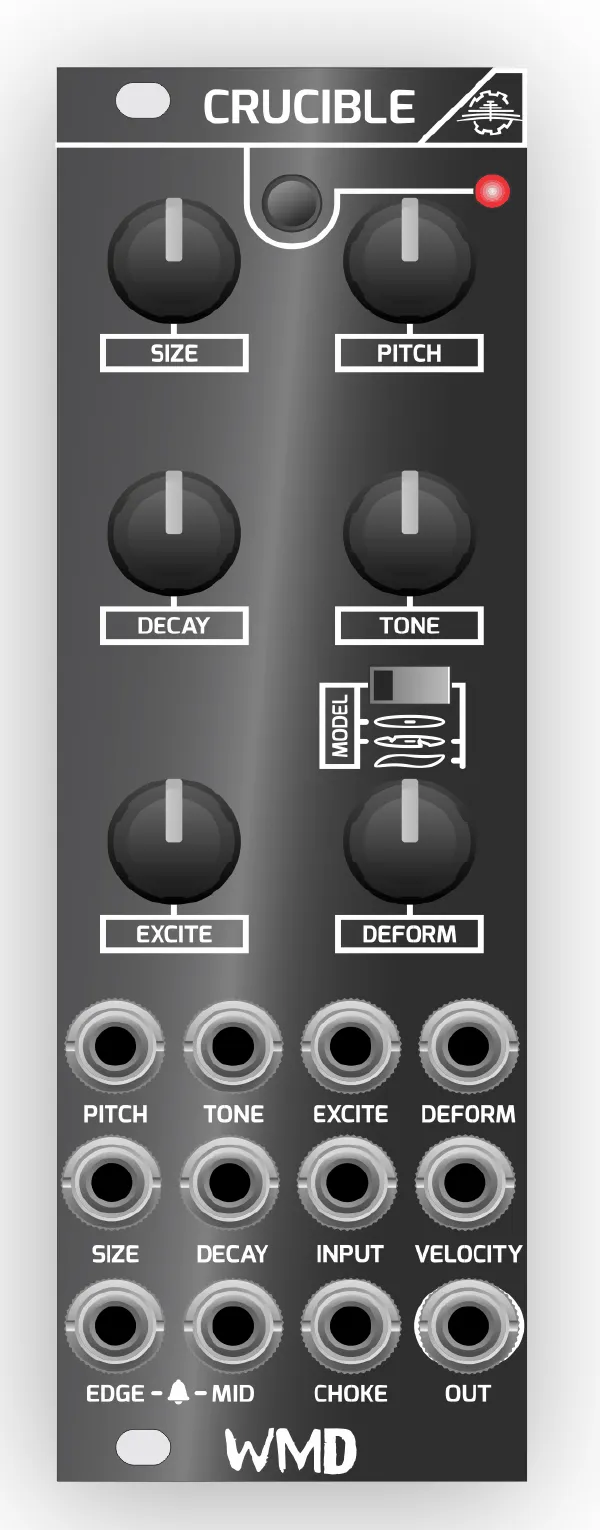
Crucible's controls fall into two groups: six knobs and a three-position MODEL switch that shape the synthesis engine, and twelve jacks at the bottom of the panel for CV control, triggering, and audio. The full reference for each follows below.
3Controls
- SIZE:
- Adjusts the “size” of the cymbal engine. Increasing this parameter will increase decay time while also affecting the frequency response of the decay.
- PITCH:
- Adjusts the “pitch” and overall spectrum of the engine.
- DECAY:
- Crucible's cymbal model contains no envelopes or VCAs! The DECAY parameter is achieved by applying a frequency independent damping constant to the engine. Turn clockwise to decrease the amount of damping applied, resulting in longer, more natural decay times.
- TONE:
- Applies frequency dependent damping to the engine. Turning clockwise will result in a “brighter” sound.
- EXCITE:
- Adjust the material and strike angle of the stick. The stick sound is brightest at the full counter-clockwise position, approximating a nylon tipped drum stick. Increasing this parameter moves toward a wood tip. Approaching the full clockwise position flattens the attack angle, causing a larger impact area between the stick and the engine. This excites more of the engine, expanding the output frequency spectrum and increasing amplitude.
- DEFORM:
- Adjusts the “thickness” of the modeled cymbal. Increasing deform will “thin” the model, making it more “crashy.”
3.1MODEL Switch
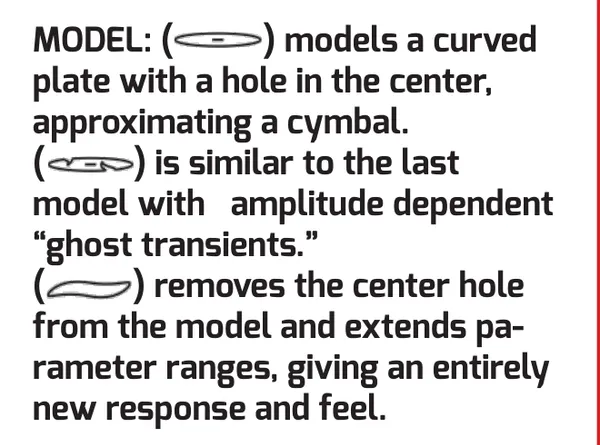
The three-position MODEL switch selects the synthesis model. Each position is marked on the panel with a cross-section icon:
Position 1 (curved plate with a hole in the center): models a curved plate with a hole in the center, approximating a cymbal.
Position 2 (same plate with added detail): similar to the first model, with amplitude dependent “ghost transients.”
Position 3 (curved plate without the center hole): removes the center hole from the model and extends parameter ranges, giving an entirely new response and feel.
4Inputs and Outputs
Each knob marked PITCH, TONE, EXCITE, DEFORM, SIZE, and DECAY has a matching CV input jack directly below the knob rows. CV inputs sum with their knobs (see Specifications). The remaining jacks are described below.
- INPUT:
- Skip the exciter and inject audio directly into the EDGE of the engine. INPUT is parallel to the exciter, so feel free to use them side by side.
- VELOCITY:
- Modify the velocity of the exciter.
- EDGE – BELL – MID:
- The status of these two jacks determines where the exciter will strike the engine. A trigger on EDGE or MID will apply the exciter to the respective position. A simultaneous trigger on both, or a gate on one and a trigger on the other, will excite the “BELL” of the engine.
- CHOKE:
- Gate input that applies strong damping to the engine, causing it to decay immediately. A minimum damp time is applied when a trigger is received. Longer gates will continue to damp the engine.
- OUT:
- Audio output of the engine.
5Specifications
Dimensions:
- Width: 8HP
- Depth: 30mm (with cables)
Power:
- +12V: 61mA
- -12V: 17mA
Inputs:
- Audio Input: 100k ohm impedance, 20Vpp range
- All CV Inputs: 100k ohm impedance; CV inputs sum with knobs, full sweep is 5V
- Gate Inputs: 100k ohm impedance, 2V threshold Schmitt Trigger
Outputs:
- Audio Output: 220 ohm impedance, 20Vpp range, 4.0ms latency max